

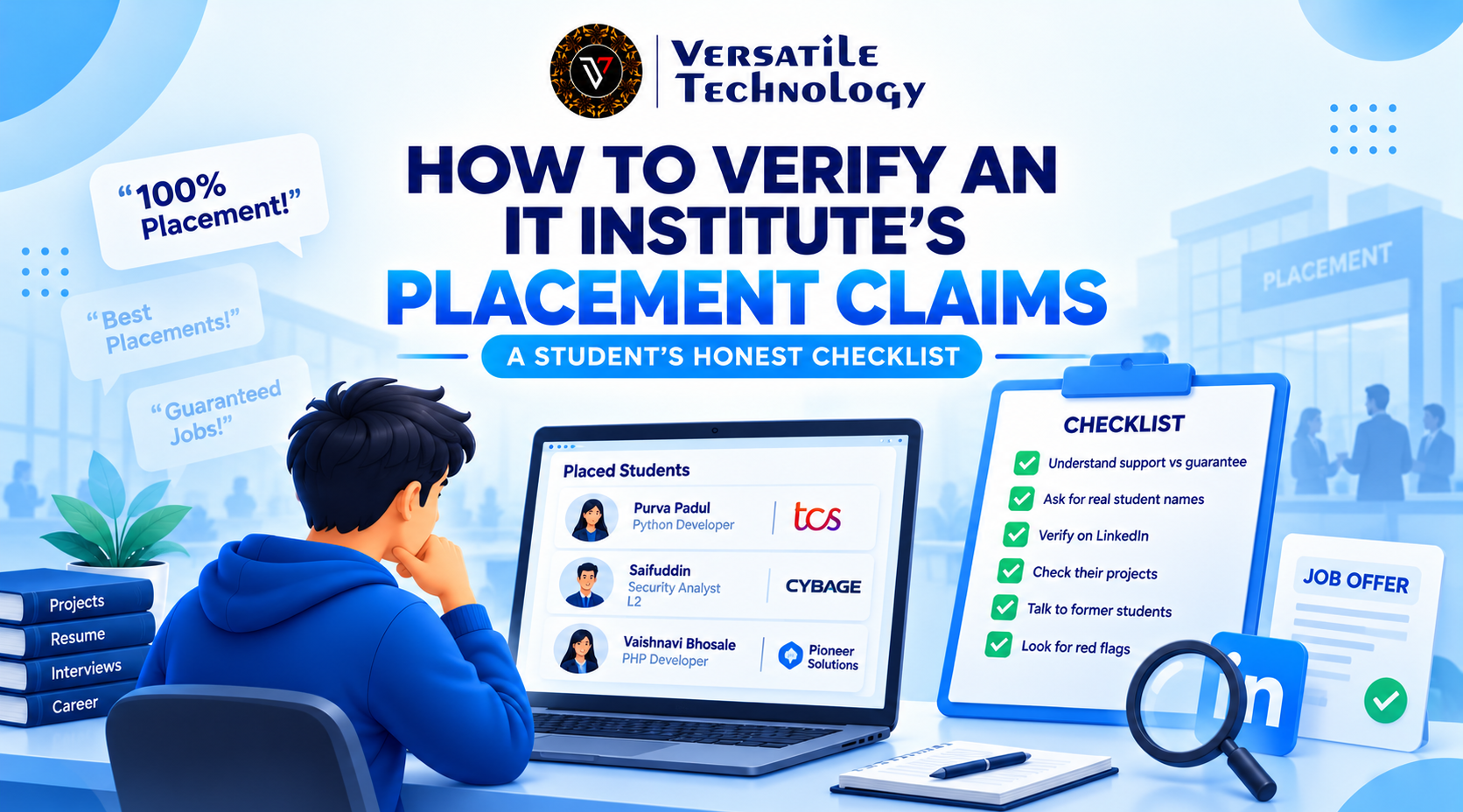
You've probably seen the line: "100% placement."
It's on almost every institute's website. It's on ours too, in the form "100% placement support". If every institute says it, the phrase stops telling you anything. So this post does something a bit unusual for an institute's blog: it teaches you how to doubt us.
By the end, you'll have a checklist you can use on any institute, including Versatile Technology. If we pass, great. If we don't, you'll know before you pay.
Let's talk like friends who want you to make a good decision.
Step 1: Learn the difference between "support" and "guarantee"
This is the most important thing in this whole post, so we'll say it plainly.
- Placement support means an institute helps you get hired: it works on your resume, trains you for interviews, introduces you to companies.
- A job guarantee means the institute promises you will be hired.
They sound similar. They are completely different promises.
No institute controls who a company hires. The company makes that decision, based on your skills, how you interview and what they need that month. So when you see "100% placement", ask yourself which one they mean. If it's a guarantee, ask what happens if you don't get a job, and ask for the terms in writing. If the answer gets vague, you've learned something.
Here's how we put it at Versatile Technology. Our placement support means:
- Resume building: a profile that stands out.
- LinkedIn optimisation: so recruiters can find you.
- Mock interviews: real feedback before real interviews.
- Aptitude and HR preparation: so no round surprises you.
- Job referrals and assistance: through our hiring network.
Those are services we provide. They are not a promise that a company will hire you, and we'd rather say so than let you assume otherwise. Your skills, effort and interview performance decide the outcome.
Step 2: Ask for names, not numbers
"500+ students placed" is a number. You can't check a number.
A name, a company and a role can be checked. So whenever an institute talks about placements, ask: "Can I see specific people, with the company and job role?"
On our homepage, we list our placements the way we'd want any institute to list theirs, with name, company and role. For example:
- Purva Padul: Python Developer, Tata Consultancy Services
- Vaishnavi Bhosale: PHP Developer, Pioneer Solutions
- Saifuddin: Security Analyst L2, Cybage
- Sakshi Salpe: Cyber Security Consultant, Secure Layer 7 US
- Shambhu Londhe: Cyber Security Consultant, ProTechmanize
- Humais Saudagar: Software Engineer, EPAM Systems US
- Vedant Chandak: Cyber Security Trainer, Nettech India
We've also published longer stories on our blog, like Purva Padul's journey to TCS, Vaishnavi Bhosale's story and Mayuri Patvardhan's move from the EHM-2 course to a Cybersecurity Analyst role.
Which brings us to the next step.
Step 3: Check the names yourself
A name on a website is where verification starts, not where it ends. Anyone can type a name on a page.
So do the detective work:
- Search the person on LinkedIn. Does their profile show the same company and role?
- Check that the company is real and that it hires for that role.
- Ask the institute if you can talk to that student. A confident institute will usually try to help you reach someone.
- Ask when it happened. Was it recently, or years ago? Both are fine, but you should know which.
Be polite about it. Former students aren't obliged to talk to strangers, but a genuine placement is usually easy to confirm.
We'd actually love you to do this with the people listed above. It's the best test of whether we're telling the truth.
Step 4: Look at the work, not just the outcome
Here's something most students miss.
A placement tells you where a person ended up. It doesn't tell you what they could do when they started. And that second thing is what predicts whether you can get the same result.
So ask to see what students built. At Versatile Technology, our student portfolios page has individual student profiles with their skills and projects. Open a few and ask yourself:
- What technologies did they use?
- Is the project simple practice, or something with real complexity?
- Can the student explain what they built and why?
- Does the work look like something you could produce after training?
We wrote a whole post about why this matters: Stop asking what a student learned, ask what they built. A certificate says you finished a course. A project shows what you can do.
Step 5: Ask who's included in the claim
This one catches a lot of people.
When an institute says "100% placement support", ask:
- Does it cover every course and every plan, or only certain ones?
- Does it cover students who attend irregularly?
- What happens if I want to freelance, start a business or study further?
For example, our course pages show job assistance and internship in the plans where they apply, and the plans differ between courses. So the honest answer to "what do I get?" depends on which plan you choose. Whichever institute you pick, ask them to tell you exactly what your plan includes, in writing if possible.
Step 6: Watch for real practice, not just promises
A strong placement result usually comes from strong preparation. So look at what the institute actually does to get you ready.
Ours, as described on our course pages:
- 150+ practice tasks that you build while learning.
- A 6-month development internship with 15+ live projects, in the plans that include it.
- 15,000+ practical interview labs to rehearse real interview questions.
- Mock interviews with feedback.
- Project and internship completion certificates, the same for online and offline students.
If an institute promises jobs but shows no evidence of preparation, that gap is worth asking about.
Step 7: Know the red flags
None of these proves an institute is dishonest, but each one is a reason to ask more questions before paying.
- A job guarantee with no written terms. Ask for the terms. If there aren't any, think twice.
- Big numbers, zero names. "Thousands placed" with not a single verifiable person.
- Stock-looking photos of "our placed students".
- Refusal to let you speak to a former student.
- No public student work anywhere.
- Pressure to pay today because "only a few seats are left".
- Salary claims that sound too good for a fresher. If it feels unrealistic, ask for proof.
- Vague answers to simple, specific questions.
Step 8: Check the institute itself
Beyond the placements, check whether the institute is a real, reachable business.
- Real addresses you can visit. Ours: Gulmandi (4-8-7 Raj-Ratan Building, Diwan Deodi), Cidco/Chilkalthana (Office No. 105, Golden City Center) and New Usmanpura (2nd Floor, above Cone-N-Cakes, Mansarovar Arcade). All three are in Chhatrapati Sambhajinagar, and the offices are open from 8 AM to 9 PM.
- Phone numbers that answer. Ours are 9370548454 and 8080503739, and the email is sales@versatiletechnology.in.
- Named people behind it. Our About page names our founders, Vivekkumar Varma and Vikram Varma, with their LinkedIn profiles.
- Independent reviews. Our site links to Google reviews so you can read what people say outside our own pages. Our reviews page has student testimonials too.
- A track record. We were founded in 2021 and have trained 500+ students, with details on the About page.
One honest note about certification. We're ISO 27001 certified for information security management (certificate number 23N880). That's a real credential about how we handle information security, but it isn't a measure of teaching quality. Don't let any institute use a certificate to distract you from the checks above, and that includes us.
Step 9: Visit, and bring questions
Nothing beats walking in. See the place, meet the trainers, sit in a demo class. While you're there, take this list:
- Can I see named placements with company and role?
- Can I speak to a former student?
- Which plan includes job assistance and the internship?
- Exactly what does placement support include, and what doesn't it?
- What do students typically build before they start interviewing?
- What happens if I'm not placed quickly?
- Can I see student projects?
If the answers are clear and specific, that's a good sign. If they're slippery, trust that feeling.
A fair warning about our own claims
We'd be hypocrites if we taught you to question everyone else and asked you to trust us blindly. So here's the invitation: check us.
Look up the people on our homepage. Read the stories on our blog. Open our student portfolios. Read our Google reviews. Visit an office and ask hard questions. If something doesn't add up, ask us about it, and if we've got something wrong, we want to hear it.
Here's what we can honestly tell you: we'll help you build real skills, give you projects and interview practice, and put our hiring network behind your job search. What we won't do is promise you a job, because the decision isn't ours to make, and anyone who tells you otherwise is selling something.
Your next step
If you're comparing institutes, use this checklist on each one. If Versatile Technology is on your list, book a free demo, browse our courses and look through the student portfolios before you decide. For the bigger picture of choosing well, read how to choose the best IT training institute in Chhatrapati Sambhajinagar and how we teach at Versatile Technology.
Frequently asked questions
Does "100% placement support" mean I'll definitely get a job? No. It describes support: resume building, LinkedIn optimisation, mock interviews, aptitude and HR preparation, and referrals. Hiring decisions are made by companies, and the outcome depends on your skills, effort and interviews.
Can I contact former students from Versatile Technology? Many of our students share their profiles publicly, and our blog and homepage name them with their roles. You can look them up on LinkedIn, and you can ask us during your visit whether a conversation can be arranged.
What's the best proof that an institute is good? Work you can inspect: student projects, public portfolios and named outcomes you can verify independently.
Are the certificates the same for online and offline students? Yes. Online and offline students receive the same certificates.
Which companies hire through your network? Our website lists placements at companies including Tata Consultancy Services, Pioneer Solutions, Cybage, Secure Layer 7 US, EPAM Systems US, ProTechmanize and Nettech India. These are examples of where students have been placed, not a promise about your own result.
What if I'm not placed quickly after the course? That's a question to ask at your demo, because the answer depends on your plan and your situation. We'd rather explain it clearly before you enrol than leave it vague.