
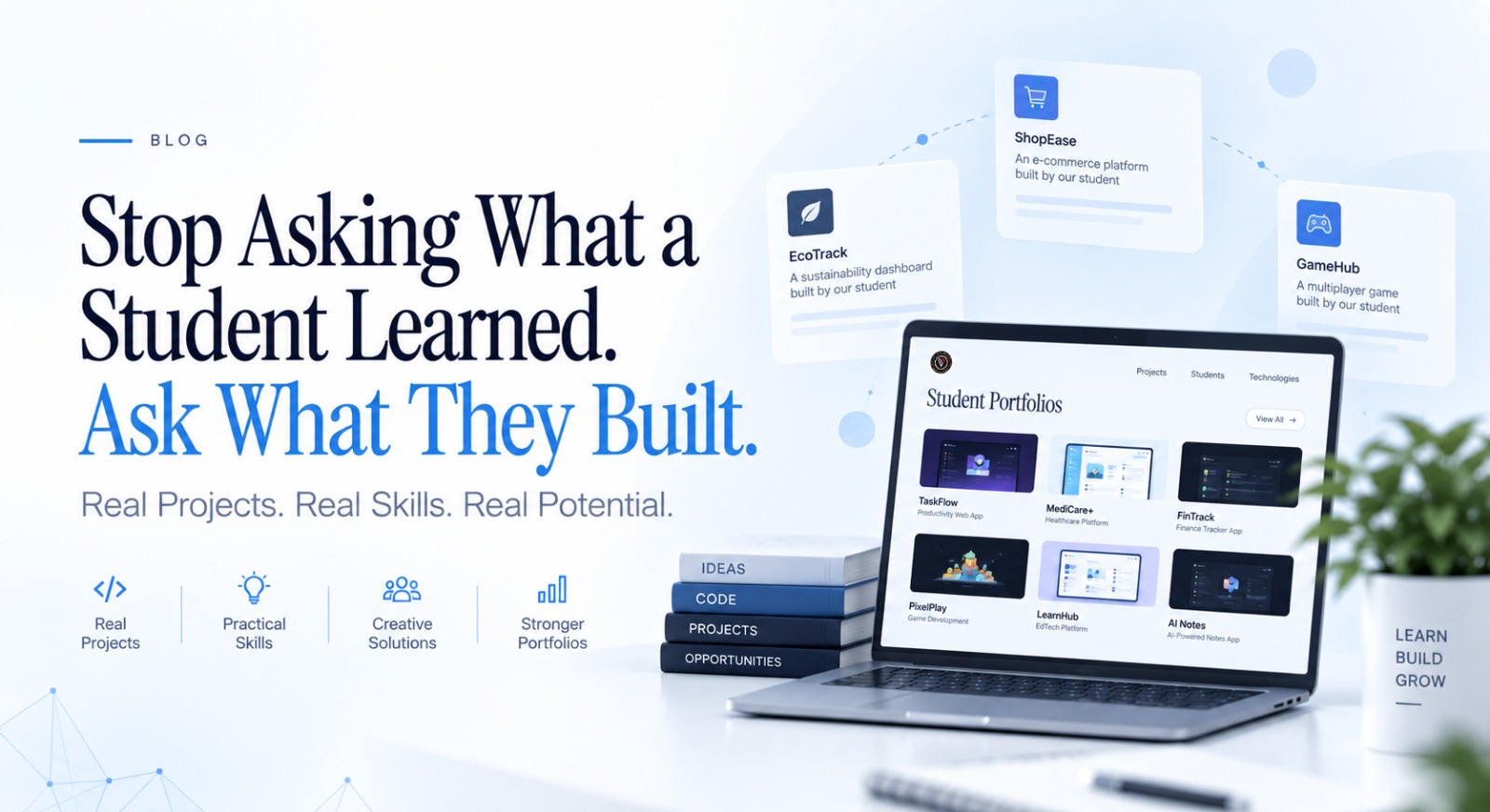
Stop Asking What a Student Learned. Ask What They Built.
When someone tells you they completed a Full Stack Development course, what does that actually tell you?
They know HTML?
JavaScript?
React?
Python?
Maybe they even have a certificate.
But there is a much better question you can ask:
“What did you actually build?”
Because knowing a technology and being able to use it to create something are two very different things.
A certificate can tell you that someone completed a course.
A project can show you what they can actually do.
Imagine two students applying for the same developer position.
Student A says:
“I completed a Full Stack Development course.”
Student B says:
“I built a complete web application, implemented authentication, created APIs, connected a database, deployed the application, and can explain every part of the system.”
Who would you want to interview?
That's why at Versatile Technology, we believe a student's work should be visible.
Not hidden inside a classroom.
Not limited to a certificate.
Built. Documented. Presented.
Welcome to the Student Portfolio
We've created a dedicated space where you can explore the work of students at Versatile Technology.
Instead of simply telling you that our students work on projects, you can see the work for yourself.
Explore their projects.
See what technologies they used.
Understand what they were trying to solve.
Look at how they approached the problem.
And, most importantly, see how their skills developed into something they could actually show to another person.
Don't just take our word for it.
See what our students built.
https://versatiletechnology.in/students/
What should you look for when viewing a student project?
Don't just look at whether the website looks beautiful.
Ask yourself:
1. What problem does the project solve?
A good project starts with a problem.
It could be a business problem, an automation problem, a security problem, or simply an idea that the student wanted to turn into a working product.
2. What technologies were used?
Look beyond the project name.
Check the technologies behind it.
Frontend.
Backend.
Database.
APIs.
Authentication.
Deployment.
Security.
The technology stack can tell you a lot about the depth of the project.
3. Can the student explain their decisions?
This is where a project becomes more valuable than a certificate.
A developer should be able to explain:
Why did you choose this technology?
How does your backend communicate with your frontend?
How is the data stored?
What happens when something goes wrong?
How did you secure it?
These questions reveal whether someone simply followed a tutorial or actually understood what they were building.
From “learning” to “building”
At Versatile Technology, our approach is centered around practical learning.
Students don't only sit through theory.
They practice.
They experiment.
They make mistakes.
They debug.
They rebuild.
And eventually, they have something they can show.
The goal isn't simply to finish another chapter.
The goal is to become capable of building something independently.
That philosophy applies across different technology tracks, including Full Stack Development, Python, Cyber Security and other programming programs offered by Versatile Technology.
Your next developer may already have a portfolio.
If you're a student thinking about joining a technology course, don't only ask:
“What certificate will I receive?”
Ask:
“What will I be able to build when I finish?”
If you're a parent, ask:
“Can I see the work produced by your students?”
If you're an employer, ask:
“Can I see what your students can actually do?”
And if you're simply curious about what students are learning today...
There's an easy way to find out.
Don't read another promise about what students can build.
Go and see what they actually built.
Explore the Versatile Technology Student Portfolios →