

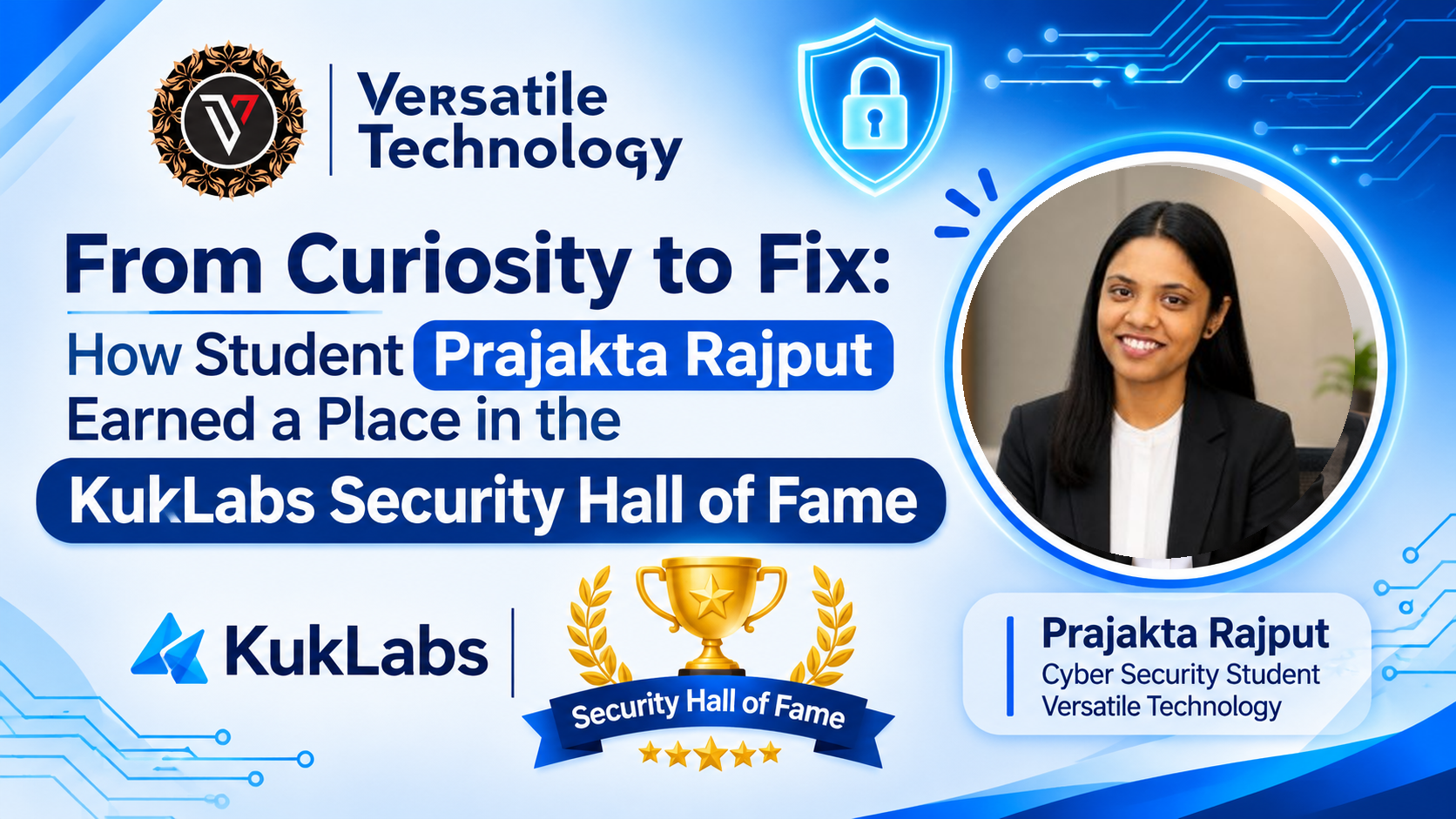
From Curiosity to Fix: How Student Prajakta Rajput Earned a Place in the KukLabs Security Hall of Fame
Versatile Technology student Prajakta Rajput spotted a flaw in a live application, reported it responsibly, and helped get it fixed. Here is how a problem solver thinks.
The short version
In October 2026, Prajakta Rajput, a Cyber Security student at Versatile Technology, reported a valid input validation vulnerability to KukLabs through its responsible disclosure program. The KukLabs security team responded quickly and fixed the issue. Prajakta Rajput has now been acknowledged in the KukLabs Security Hall of Fame.
For us, the credit matters less than how she got there. She treated a security flaw as a problem to be solved, not a trick to show off.
What is a problem solver in cyber security?
Many people picture a hacker as someone who breaks things. The best security researchers do the opposite. They notice what is broken, work out why, and help fix it. Prajakta Rajput’s report followed the same steps every good problem solver uses:
- Observe. Notice that an application handles user input in a way it shouldn’t.
- Question. Ask what happens when input is not what the developer expected.
- Verify. Confirm the behaviour is repeatable and is a real flaw, not a one-off glitch.
- Document. Write down the exact steps, the impact and a suggested fix.
- Report responsibly. Send it privately to the owner through their official program, not publicly and not to an unauthorised party.
- Follow through. Work with the security team until the issue is resolved.
The result was a flaw that no longer exists, which protects every user of that application.
Why input validation is such a classic problem
Input validation is one of the first topics every web security student learns, and one of the most common causes of real-world vulnerabilities. Applications accept data from users all the time, in forms, search boxes, URLs and APIs. If that data isn’t checked properly, the application can behave in ways its developers never planned.
The OWASP Top 10 lists several risks that stem from improper handling of input. That is why we train students to treat every input as untrusted until it is validated.
Why this achievement matters
- The report was valid. KukLabs confirmed the vulnerability and fixed it. That is real, verifiable impact.
- It is a public credit. A Hall of Fame listing is visible to hiring managers and shows that a student can follow rules and communicate with a professional security team.
- It was done legally. [Student Name] tested through an official disclosure program, which is the first rule of ethical hacking.
- It shows a mindset, not just a skill. Employers can teach tools. They can’t easily teach curiosity, patience and ownership.
How Versatile Technology builds problem solvers
[Student Name]’s result came from steady practice, not luck. Our Cyber Security course is built around solving problems, not memorising theory.
| Stage | What students do at Versatile |
|---|---|
| Foundations | Learn HTTP, authentication, databases and the OWASP Top 10 |
| Labs | Practise on deliberately vulnerable apps under trainer guidance |
| Methodology | Learn to map an app, test inputs and document findings |
| Reporting | Write short, reproducible reports with impact and a suggested fix |
| Ethics and legality | Understand scope, safe-harbor rules and responsible disclosure |
Our batches are small, with a maximum of 3 students, so trainers can review each student’s notes and reports personally and push them to think, not just follow steps.
5 lessons for aspiring security researchers
- Think like a problem solver, not a show-off. The goal is a safer product, not a screenshot.
- Stay in scope. Read a program’s rules before testing anything. It keeps you legal and trusted.
- Write clearly. A short report with exact steps and a suggested fix gets taken seriously.
- Be patient and professional. Respond politely, answer follow-up questions and give the team time to fix.
- Keep learning. Every report, whatever the outcome, teaches you how defenders think.
Further reading
- OWASP Top 10: the standard list of critical web application risks.
- PortSwigger Web Security Academy: free, hands-on labs for practising legally.
- OWASP Input Validation Cheat Sheet: practical guidance on validating input safely.
FAQ
What is a Security Hall of Fame?
It is a public page where a company thanks researchers who responsibly reported valid security issues. It usually lists the researcher’s name and sometimes the issue or date.
What is an input validation vulnerability?
It is a weakness that arises when an application does not properly check the data users send to it. Proper validation makes sure only expected, safe input is accepted.
What is responsible disclosure?
It means reporting a vulnerability privately to the owner, with enough detail to fix it, and giving them time to do so before anything is made public.
Can a student really find a valid vulnerability?
Yes. With solid fundamentals, practice on legal labs and a careful, patient approach, students can report valid issues through official disclosure programs.
Does Versatile Technology teach ethical hacking?
Yes. Our Cyber Security course covers ethical hacking, penetration testing and security auditing, with small batches, hands-on labs and placement support.
Where can I join a cyber security course in Chhatrapati Sambhajinagar?
Versatile Technology runs in-person Cyber Security batches at its Gulmandi and Chilkalthana offices. You can book a meeting to see the syllabus and meet the trainers.
Ready to become a problem solver?
Whether you are a complete beginner or already know the basics, our trainers will help you build real, provable skills.
- Explore the Cyber Security course
- Meet more student success stories
- Book a free meeting or call 9370548454 / 8080503739
Versatile Technology is an ISO 27001 certified (Certificate No. 23N880) training institute and software company in Chhatrapati Sambhajinagar and Pune, Maharashtra.