

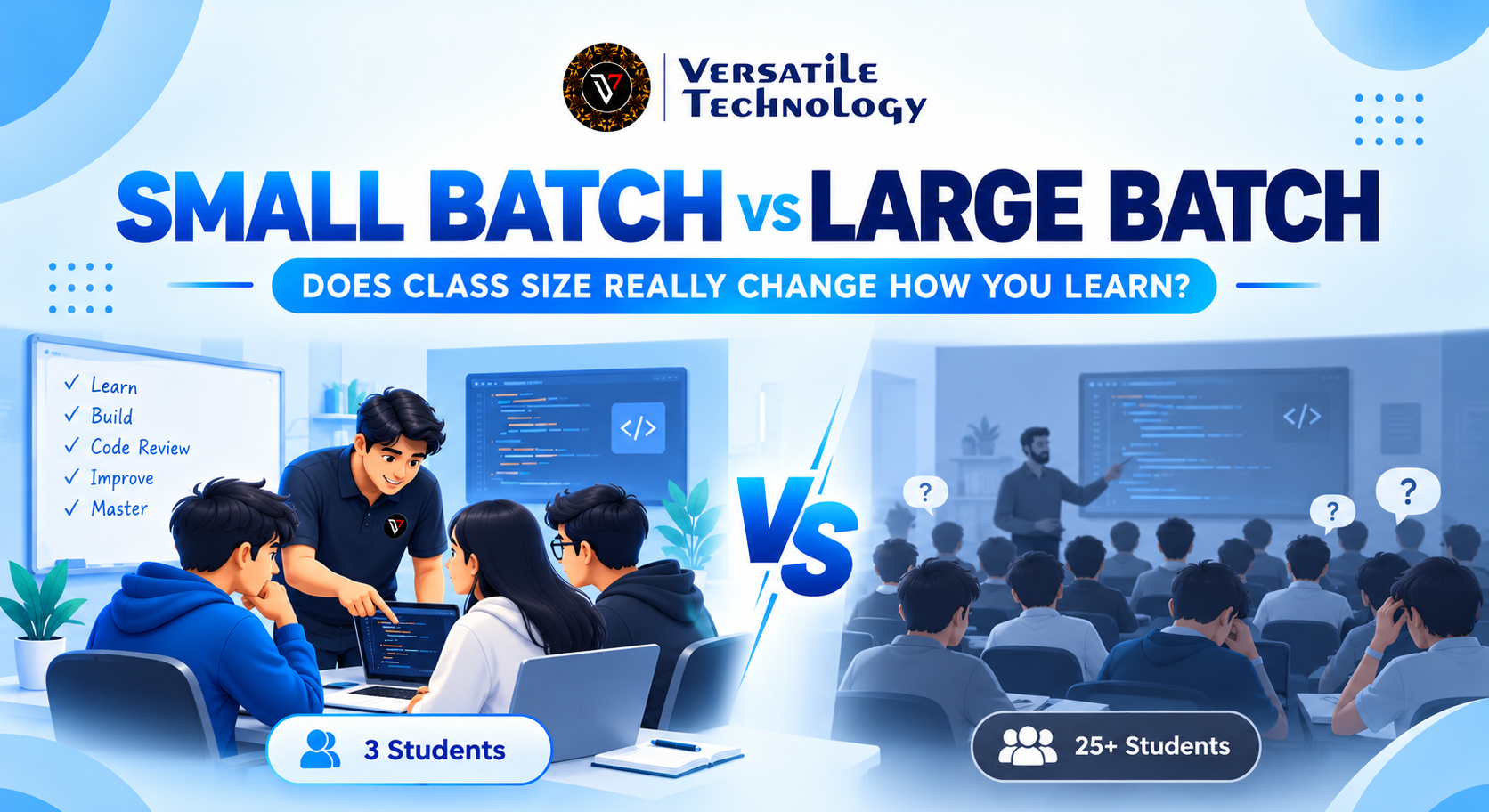
At Versatile Technology, we limit every batch to a maximum of three students. We say it on our homepage, on every course page and in almost every conversation with a new student. So you could be forgiven for thinking it's just a marketing line.
It isn't, but it also isn't magic. A small batch doesn't automatically make someone a better teacher, and a big batch doesn't automatically make someone a worse one. What changes is what's possible. This post is about that difference, and about how you can tell whether a number on a website is actually doing anything for you.
Think of it as a chat over chai about something that quietly decides how your next few months of learning will go.
First, what do we even mean by "batch"?
A batch is simply the group of students who learn together with one trainer. In some places that's 5 people. In others it's 20, 30, even more. Same syllabus, same trainer, very different experience.
Why? Because of one boring but powerful thing: a trainer's time is fixed. Whatever hours they have, they split across everyone in the room. More students, smaller slice each.
Now let's see what that slice looks like when you're learning to code.
Picture a large batch
Imagine you join a batch of 25 students.
The trainer explains how loops work. It makes sense to about half the room. A few people nod, a few look confused, and a couple have already drifted off to their phones. The trainer asks, "Everyone clear?" Silence, a few nods. On to the next topic.
Here's the problem. You were in that confused group, but you didn't want to be the person who slows down 24 others. So you stay quiet and plan to figure it out at home.
At home, you try the practice problem. You get an error you don't understand. You search online, copy a solution, it works, and you move on without really knowing why.
Two weeks later, the next topic builds on loops. Now you're lost in a way that's harder to fix, because the gap is older and bigger.
Nobody did anything wrong in that story. The trainer taught well. You tried your best. It's just that with 25 people, there was no moment where anyone could notice you specifically were stuck.
That's the real cost of large batches in a skill like programming: confusion goes unnoticed, and confusion compounds.
Now picture a batch of three
Same topic: loops.
The trainer explains the concept, then gives each of you a small task. While you work, the trainer is actually watching, not at the front of a room but at your screen, with only two other students to look after.
You make the classic mistake and get stuck in an infinite loop. In a big class, you'd quietly struggle and maybe give up. Here, the trainer sees it within a minute, asks you what you expected to happen, and helps you work out where your thinking went wrong. You fix it yourself, and that "aha" moment sticks, because you earned it.
Then your code gets reviewed. Not just "does it run?" but "is this the clean way to write it?" And if the concept still isn't clear, the group stays on it until it is, before moving on.
That's what we mean when we say "personal attention". It's not a luxury feature. It's the ability to catch a misunderstanding on day three instead of week three.
This is the loop we follow in every course
Our course pages describe a simple cycle that repeats for every concept:
- Learn: the trainer explains the concept.
- Get a task: a real problem is assigned.
- Build: you write your own code.
- Code review: we review your work and guide you.
- Fix and improve: you correct, optimise and improve it.
- Master: when the concept is clear, you move to the next one.
Look at steps 3, 4 and 5. They need someone to read your work and respond to it. With three students, that's realistic after every task. With thirty, it simply isn't, and that's why the small batch and the review loop go together. One makes the other possible.
You'll find that same process on all our courses: Full Stack Development, Cyber Security, Python, C, C++ and Basic Computers. And our classes are live, not recorded, so you can ask questions at the exact moment you're confused.
Now, the honest part: size alone proves nothing
Here's where we want to be careful, because we've seen institutes use "small batch" as a slogan and then not do anything with it.
Consider two scenarios:
- Scenario A: Three students. The trainer lectures for the whole session, gives no tasks and never looks at anyone's code.
- Scenario B: Ten students. The trainer has a clear structure, gives every student tasks and reviews their work regularly.
Which would you rather be in? Scenario B might honestly teach you more than A, even though the batch is bigger.
So a small number isn't the point. What happens to your individual work is the point. A small batch is just the condition that makes that possible. This is why, when you compare institutes, "how many students?" should be your first question and not your last. The follow-up, "and what does the trainer do with that?", is where you learn the truth.
What small batches are not good at
We'd be lying if we said small batches were perfect for everyone. Here's what you give up, honestly:
There's nowhere to hide. In a big class you can sit quietly at the back for a week. In a batch of three, the trainer will notice if you haven't practised. For most learners that's actually the point, but it can feel intense if you're shy at first.
Fewer classmates. If you love the buzz of a big room, lots of people to chat with, group energy, a batch of three will feel quieter. That's a real difference, and some people prefer the bigger crowd.
Less anonymity for questions. Some students find it easier to ask questions when they're one of many. In a small group, every question is "yours". Most people get comfortable quickly, but it's worth knowing.
If those trade-offs bother you, tell us. It's better you know before you join than after.
Do small batches also apply to online classes?
Yes. Our course pages list both in-person and online modes, with a maximum of three students per batch and live, trainer-led sessions. And the certificates you earn are the same whether you attend at one of our offices or join online. The method stays the same: concept, task, your own code, review, improvement.
Seven questions to ask any institute about batch size
Take this list to every institute you visit. You'll learn a lot from how they answer:
- "What's the maximum batch size?" Ask for a number, not "small".
- "Is that a maximum or an average?" Averages can hide batches much bigger than the number.
- "Who reviews my code, and how often?" If the answer is vague, the small size isn't being used.
- "What happens if I don't understand a topic?" Look for "we revisit it", not "ask someone later".
- "Are the sessions live or recorded?" Recorded content doesn't care how many students there are.
- "Can I see a demo class with the actual batch size?" A real demo shows more than any brochure.
- "Can I see what students from this batch built?" The output reveals the teaching.
How to test it yourself in a demo class
You don't have to take our word for any of this. When you attend a demo (we offer a free one), watch for these four things:
- Does the trainer ask you something, instead of only talking?
- Does the trainer give you a small task and look at what you wrote?
- Do you feel able to say "I didn't get that" without feeling rushed?
- Does the pace feel right for you, not for an imaginary average student?
If all four are true, the batch size is doing real work. If they aren't, no number on a website will fix it. That applies to us too, so please test us.
What we think is the real benefit
Here's the simplest way we can put it.
Learning to code isn't about hearing explanations. You can find those anywhere, for free. It's about the cycle of trying, failing, understanding and trying again, and that cycle runs fastest when someone is paying attention to your attempts.
That's what small batches buy you: faster feedback, earlier correction and fewer weeks wasted being quietly confused. It's also why our courses say things like "no copy-paste learning" and "only you, your trainer and code". They describe a goal, and the demo is where you check whether we meet it.
Who we're probably not right for
If you want a big, lively classroom with dozens of classmates, a small batch will feel quiet. If you'd rather learn alone from recorded videos on your own schedule, our live format isn't what you're after. And if you'd like to sit at the back and be left alone, we'll gently disappoint you.
But if you want someone watching your progress closely enough to catch problems early, we think you'll like how we teach.
Your next step
Visit, ask and compare. See how we work in practice by reading how we teach at Versatile Technology and what actually happens after you enroll. You can also browse our student portfolios to see what students from these small batches have built, or look at all our courses.
When you're ready, book a free demo at any of our three offices (Gulmandi, Cidco/Chilkalthana or New Usmanpura) and judge the batch yourself. If you're still deciding between institutes, our guide on how to choose the best IT training institute will help.
Frequently asked questions
Is the batch size really a maximum of three students? Yes. Our course pages state a maximum of three students per batch. Confirm it during your demo if you'd like to see it for yourself.
Does a small batch guarantee better results? No. It makes better teaching possible, but your effort and the quality of review also matter. That's why we focus on the learning loop and not just the number.
Are small batches available online too? Yes. Our courses are available in-person and online with the same maximum batch size and live, trainer-led approach.
Will I get the same certificate if I learn online? Yes. Online and offline students receive the same certificates.
What if I'm shy about asking questions? That's very common. In a small group, the trainer usually notices when you're stuck and checks in, so you don't have to be the one to speak up first.
Is a bigger batch ever the better choice? It can be, if you thrive in a large group and the institute has a strong structure for tasks and review. What matters most is whether your individual work gets seen.