

React vs Angular vs Next.js in 2027: Which Should You Learn First?
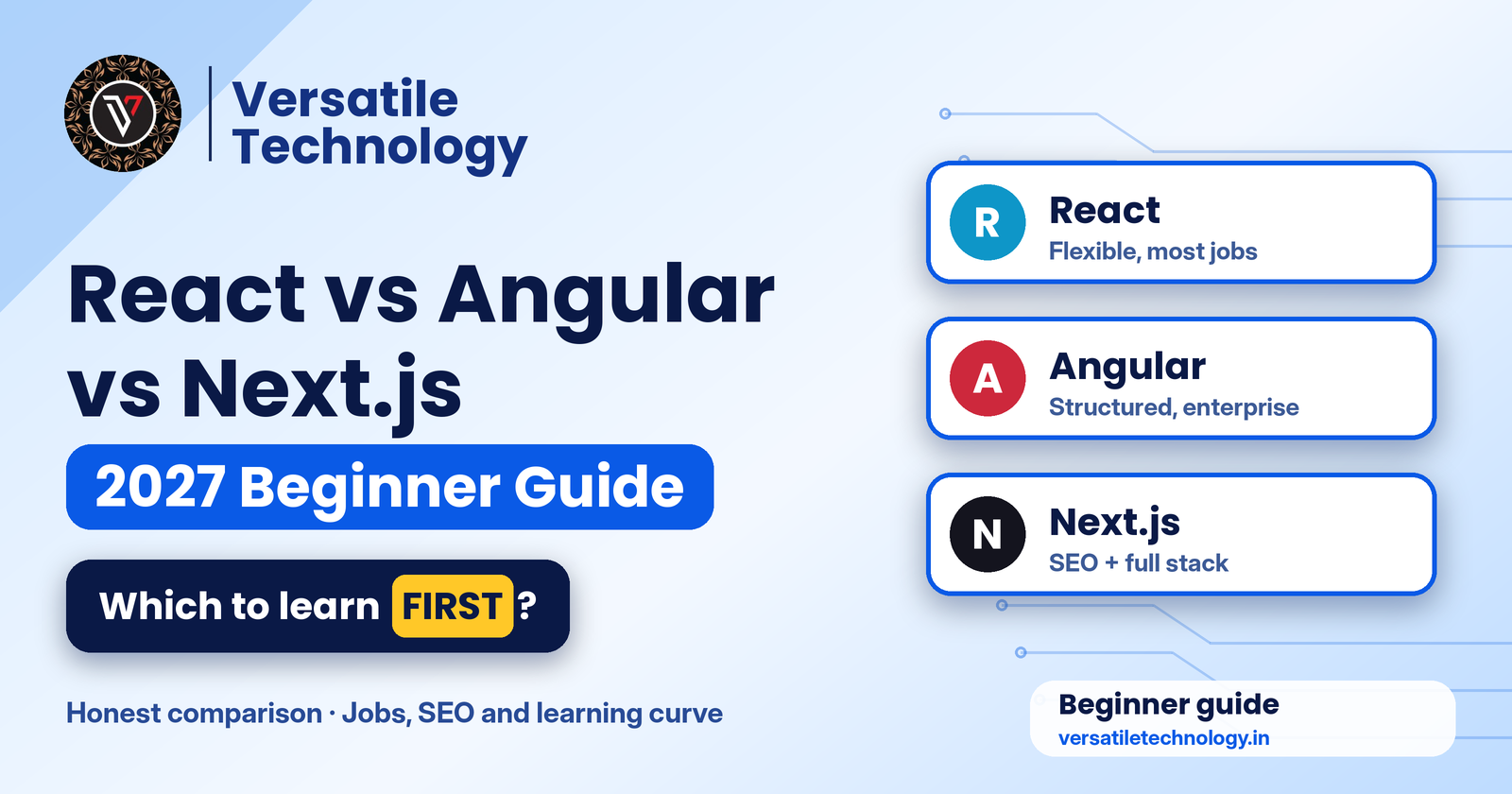
For most beginners, learn React first, then add Next.js when you want SEO, routing and full-stack features. Choose Angular if you are aiming at large enterprise teams, banks or government projects where strict structure matters. React is a UI library, Next.js is a framework built on top of React, and Angular is a complete framework of its own, so the real decision is "React plus Next.js" or "Angular". Whichever you pick, learn solid JavaScript first.
That is the short answer. The rest of this guide compares the three on jobs, learning curve, SEO, speed and use cases, and ends with a simple plan you can follow.
What Are React, Angular and Next.js?
React is a JavaScript library for building user interfaces from reusable components. It focuses on the view layer, so you choose your own tools for routing, forms and state.
Angular is a full front-end framework maintained by Google. It ships with routing, forms, dependency injection and testing built in, and it uses TypeScript. Its release cycle is steady, and Angular 22 was released in mid-2026.
Next.js is a framework built on React. It adds file-based routing, server-side rendering, static generation, API routes and a build system, so one project can handle both the front end and parts of the back end. The 16.x line is current at the time of writing.
A common beginner mistake is treating "React vs Next.js" as a competition. Next.js uses React, so learning React comes first.
Quick Comparison Table
| Factor | React | Angular | Next.js |
|---|---|---|---|
| Type | UI library | Full framework | React framework |
| Language | JavaScript or TypeScript | TypeScript | JavaScript or TypeScript |
| Learning curve | Moderate | Steeper | Moderate to steeper (needs React first) |
| Built-in routing, forms | No (add libraries) | Yes | Routing yes, forms via libraries |
| SEO-friendly rendering | With extra setup | With Angular SSR | Strong, built in |
| Best for | Startups, SaaS, MVPs | Large enterprise apps | SEO-heavy sites, e-commerce, full-stack apps |
| Hiring pool | Very large | Smaller, enterprise-focused | Large, shares React skills |
Jobs and Demand in 2027
React leads on usage. In the Stack Overflow Developer Survey 2025, about 44.7% of professional developers used React, compared with about 18.2% for Angular. Several comparisons also report roughly twice as many React job postings as Angular ones on major platforms, although the exact ratio varies by country and source.
Angular still has a clear place. It is common in banking, healthcare, insurance and government work, where large teams value strict conventions. If your target is a big enterprise or a service company with Angular projects, it can be a strong differentiator.
Next.js appears increasingly alongside React in job descriptions, especially for public-facing sites, SaaS products and e-commerce. Many "React developer" roles now expect basic Next.js knowledge too.
What this means in India: job availability differs by city and company type. Before you decide, search Naukri, LinkedIn and Indeed for your own city and note which framework appears most in junior roles.
Learning Curve: Which Is Easiest?
- React: easier to start because you can build a working page quickly. The challenge is choosing tools for routing, state and data fetching.
- Angular: takes longer because you learn TypeScript, modules or standalone components, signals, dependency injection and RxJS-style patterns together. The reward is a consistent structure once it clicks.
- Next.js: easy once you know React, but it adds concepts such as server and client components, rendering modes and caching. Learn it second.
For all three, the biggest factor is your JavaScript fundamentals. If you struggle with arrays, objects, functions, async code and the DOM, every framework will feel hard. Our Full Stack Developer Roadmap 2027 shows where JavaScript and frameworks fit in the learning order.
SEO and Performance
Search engines can index JavaScript apps, but pages that arrive fully rendered are usually easier to crawl and faster on slow phones.
- Plain React (client-side): the browser builds the page, which can slow the first load and need extra SEO work.
- Next.js: renders pages on the server or at build time by default, which helps SEO and first-load speed. That is why it is popular for blogs, business sites and online stores.
- Angular: supports server-side rendering through its own tooling, so it is also capable, but setup choices differ from Next.js.
If your project is a marketing site, blog or store that needs to rank on Google, Next.js is usually the most practical choice. For a logged-in dashboard where SEO does not matter, plain React or Angular is fine.
Which Should You Choose?
| Your situation | Best pick |
|---|---|
| Complete beginner who wants the widest job options | React, then Next.js |
| Student building portfolio projects | React (with Tailwind CSS) |
| Building a blog, store or business site that must rank | Next.js |
| Aiming at banks, government or large enterprise teams | Angular |
| Want a full-stack JavaScript project in one codebase | Next.js with a database |
| Prefer strict structure and built-in tools | Angular |
| Not sure yet | React, because the skills transfer to Next.js and React Native |
Do not try to learn all three at once. Pick one path, build projects, and add the next tool only when the first one feels comfortable.
A Simple Learning Plan for Beginners
- HTML and CSS (6 to 8 weeks). Build a responsive page. See our student portfolio example built with HTML, CSS and Tailwind.
- JavaScript (8 to 10 weeks). Functions, arrays, objects, DOM,
fetchand async code. - React (6 to 8 weeks). Components, props, state, hooks and calling an API.
- Next.js (3 to 4 weeks). Routing, server rendering and deployment.
- Back end and database. Node.js or Python, REST APIs and SQL.
- Projects and GitHub. Deploy at least three projects, with one that has login and a database.
Need project ideas to practise on? See our Full Stack Project Ideas for Students 2027.
Learn It Hands-On in Chhatrapati Sambhajinagar (Aurangabad)
Searching for the best full stack developer course or a web development institute in Chhatrapati Sambhajinagar? At Versatile Technology you learn in-person, in small batches of a maximum of 3 students, with hands-on classes, live projects and placement support. Our Full Stack Development course follows the same path as this guide: web basics, JavaScript, a front-end framework, back end and databases, then deployment.
Not sure which framework suits your goal? Book a free demo session and our trainers will help you choose, and explain the exact syllabus so you know what you will learn. You can also compare all our courses or see what past students have built on the Student Portfolios page.
Frequently Asked Questions
Should I learn React or Angular first in 2027? For most beginners, React. It has a larger job pool, a gentler start and skills that carry over to Next.js and React Native. Choose Angular if you are targeting enterprise, banking or government roles that use it.
Is Next.js better than React? They are not direct rivals, because Next.js is built on React. Use Next.js when you need SEO, server rendering, routing and full-stack features. Use plain React for apps where SEO does not matter, such as internal dashboards.
Can I learn Next.js without learning React? Not really. Next.js assumes you understand React components, props, state and hooks. Learn React first, then add Next.js.
Is Angular still worth learning in 2027? Yes. Angular is actively maintained, with a major release every year, and it is common in enterprise and government projects. It has fewer total jobs than React but can be a strong choice for those sectors.
Which framework is best for SEO? Next.js is usually the most practical because it renders pages on the server or at build time by default. Angular also supports server rendering, and plain React needs extra setup.
Do I need TypeScript? Angular requires it, and many React and Next.js teams use it too. Learn JavaScript well first, then add TypeScript.
Which one is easiest for a complete beginner? React, after you learn JavaScript. Angular has the steepest learning curve at the start, and Next.js is easiest once you know React.
Which framework gets more freelance work? React and Next.js are common for freelance sites and apps, especially landing pages, stores and SaaS prototypes. Demand depends on your clients, so check freelance platforms for your area.
How long does it take to learn React? Most beginners with JavaScript basics need about 6 to 8 weeks of regular practice to build real React projects. Total time to job-ready full stack skills is longer, usually 8 to 12 months with consistent practice.
Where can I learn React and full stack development near me? Versatile Technology offers in-person full stack training in Chhatrapati Sambhajinagar (Aurangabad) with small batches, live projects and placement support. Book a free demo to see how classes work.
Final Thoughts
In 2027 the best choice is the one you will actually finish learning and use to build projects. For most beginners that means JavaScript, then React, then Next.js. Pick Angular if you are aiming at enterprise roles. Whatever you choose, build real projects, put them on GitHub and keep improving.
Framework versions and survey numbers change often, so check the official React, Angular and Next.js websites for the latest releases before you start a project.
Ready to Start Your Full Stack Journey?
- Explore our Full Stack Development course
- Read the Full Stack Developer Roadmap 2027
- Browse student portfolios and projects
- Book a free demo session
Visit us:
- Gulmandi: 4-8-7 Raj-Ratan Building, Diwan Deodi, Chhatrapati Sambhajinagar 431001
- Chilkalthana (Cidco): Office No. 105, Golden City Center, Chhatrapati Sambhajinagar 431001
- New Usmanpura: 2nd Floor, above Cone-N-Cakes, Mansarovar Arcade, Sant Eknath Rang Mandir Road, New Usmanpura, Chhatrapati Sambhajinagar (Aurangabad), Maharashtra 431005
- Call: 9370548454 / 8080503739
- Email: sales@versatiletechnology.in