
Full Stack Developer Roadmap 2027: A Beginner's Step-by-Step Guide
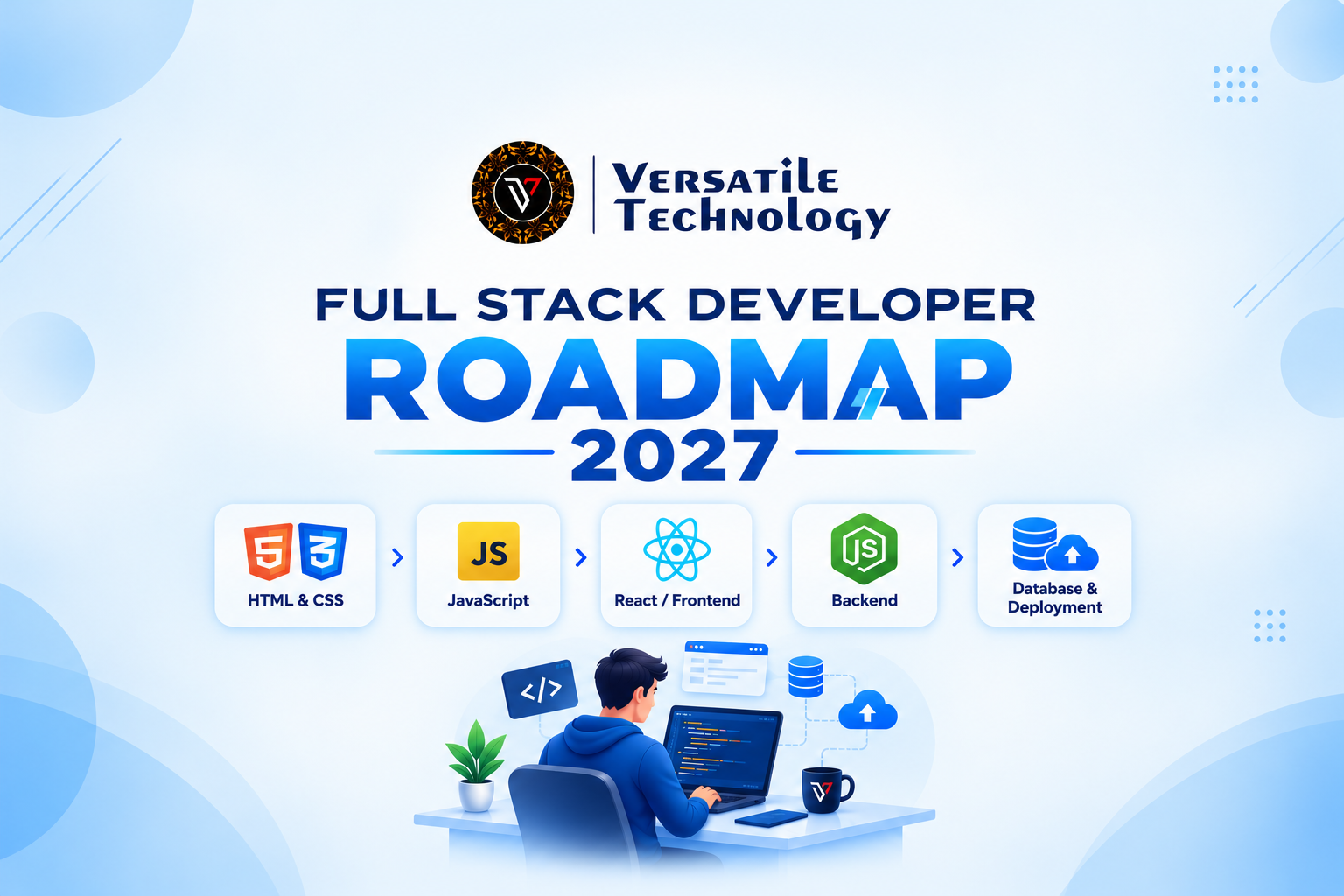
A full stack developer is someone who can build both the part of a website users see (the front end) and the part that runs behind it (the back end and database). The most reliable way to become one is to learn in layers: HTML and CSS, then JavaScript, then one front-end framework, then a back-end language and database, and finally Git and deployment. Build a project at every stage.
That is the short answer. The rest of this guide explains each stage, what to build, what to skip, and how students at Versatile Technology in Chhatrapati Sambhajinagar (Aurangabad) follow this path in small batches of a maximum of 3.
What Is a Full Stack Developer?
A full stack developer is a software developer who works on every layer of a web application. On the front end, they build pages and interfaces using HTML, CSS and JavaScript. On the back end, they write server logic, connect databases and build APIs. They also handle version control, security basics and deployment.
Companies like full stack developers because one person can take a feature from idea to a live link. Small businesses and startups, in particular, often hire one developer to do the work of several.
The Roadmap at a Glance
| Stage | What you learn | What you build |
|---|---|---|
| 1. Web basics | HTML, CSS, responsive layout | A personal portfolio page |
| 2. JavaScript | Functions, arrays, DOM, async code | A quiz, calculator or typing game |
| 3. Front-end framework | React, components, state | A multi-page app that calls an API |
| 4. Back end | Python or Node.js, REST APIs | A login system with a server |
| 5. Databases | SQL, data modelling | An app that saves real records |
| 6. Git and GitHub | Commits, branches, pull requests | Every project, on GitHub |
| 7. Deploy and secure | Hosting, HTTPS, input validation | 15+ live project a real person uses |
Step-by-Step: The 7 Stages
Stage 1: Learn HTML and CSS First
What is the first thing to learn in web development? Start with HTML for structure and CSS for styling. Together they control everything a visitor sees on a page. You can learn the basics in days, and they make every later stage easier because you can see your work in the browser immediately.
Focus on:
- Semantic tags such as
<nav>,<main>and<button> - Flexbox and grid for layout
- Responsive design, so pages work on phones
Many students also pick up Bootstrap or Tailwind CSS at this point. Learn plain CSS first so you understand what those tools are doing for you.
Stage 2: Learn JavaScript Properly
JavaScript makes pages interactive. Spend real time here, because every framework you learn later is built on it.
Learn variables, functions, scope, arrays and objects, DOM manipulation, events, fetch and asynchronous code. If you skip these and jump to React, every error will look like magic. For a longer list of what to avoid, read our guide on web development mistakes to avoid.
Stage 3: Pick One Front-End Framework
Do I need to learn React to become a full stack developer? React is the most common choice and a safe one to start with, but it is not the only option. Pick one framework, learn it well, and move on. The ideas you learn, such as components, state and props, transfer to other tools.
Only start this stage when you are comfortable with plain JavaScript.
Stage 4: Learn a Back-End Language
The back end handles logins, business rules and data. Two common paths:
- Python with Django or Flask. Python is beginner-friendly and also opens doors to automation, data science and AI. See our Python Programming course.
- Node.js with Express, if you want to use JavaScript everywhere.
Whichever you choose, learn how to build and consume REST APIs, how authentication works, and how to keep passwords hashed and secrets out of your code.
Stage 5: Learn Databases
What database should a beginner learn? Start with a relational database and SQL. SQL is used across industries, teaches you how to model real-world data, and appears in most job interviews. Learn tables, relationships, joins and basic queries before exploring other database types.
Stage 6: Use Git and GitHub from Day One
Do not wait until you "have something good enough" to put on GitHub. Make small commits with clear messages, and push every project. Recruiters look at GitHub profiles, and a steady history shows you work like a professional. Add .env files and API keys to .gitignore before your first commit.
Stage 7: Deploy and Secure Your Work
A project on your laptop proves little. A deployed project with a live link proves a lot. Learn to host a site, set up HTTPS and validate every piece of user input. Treat forms, URL parameters and API requests as untrusted. Learning the basics of the OWASP Top 10 early makes you a stronger developer, which is why our Full Stack and Cyber Security tracks work well together.
Should You Use AI Tools While Learning?
Yes, but carefully. AI tools are useful for explaining errors, suggesting alternatives and reviewing your code. They can also give confident answers that are outdated, insecure or simply wrong.
A simple rule: write your first attempt yourself, then use AI to review or unblock you, and read everything before it goes into your project.
How Long Does It Take to Become a Full Stack Developer?
How long does it take to learn full stack development? There is no fixed answer. It depends on your starting point, how many hours you practise each week, and whether you build projects along the way. Most beginners need several months of consistent, project-based practice to reach job-ready basics. Structured guidance and regular code review usually shorten the journey.
See What Our Students Have Built
A certificate shows what a student completed. A project shows what they can build. That is why every student at Versatile Technology builds work they can show, and why we publish their profiles for anyone to see.
Browse the full gallery: Student Portfolios at Versatile Technology
A few portfolios to explore, with the stack each student lists on their profile:
| Student | Stack on their profile | Portfolio |
|---|---|---|
| Gaurav Kondke | HTML, CSS, Bootstrap, Tailwind | View portfolio |
| Ansh Yadav | Python, HTML and CSS, SQL, Git | View portfolio |
| Chishti Kashifuddin | Python, HTML, CSS, JavaScript, SQL | View portfolio |
| Madhushree Rasal | JavaScript, HTML, CSS, Tailwind CSS | View portfolio |
| Akash DineshKumar | HTML, Git and GitHub, Visual Studio | View portfolio |
Real Products Built by Our Team
Beyond student work, Versatile Technology ships real products. These show the kind of full stack applications you learn to build:
- TypeClash: a competitive typing arena for speed typists
- Get my saloon: salon queue and management
- Doc24: clinic management
- ShahiDesk: hotel and restaurant management
- Versatile Bug Bounty: web security tested by real people
See all of them on the Platforms page.
Where Our Students Work Now
Several Versatile Technology students have gone on to developer and security roles. Purva Padul joined Tata Consultancy Services as a Python Developer, Vaishnavi Bhosale became a PHP Developer at Pioneer Solutions, and Humais Saudagar is a Software Engineer at EPAM Systems. Read their stories on our blog and the student reviews page.
Explore Our Courses
Versatile Technology offers 10+ industry-aligned courses with hands-on labs, live projects and placement support. These are the best starting points for this roadmap:
| Course | Best for | Link |
|---|---|---|
| Full Stack Development | Learning front end and back end together | View course |
| Python Programming | Back end, automation, data and AI paths | View course |
| Cyber Security | Adding security skills to your development | View course |
| C Programming | Building strong programming fundamentals | View course |
| C++ Programming | Object-oriented programming and DSA | View course |
| Basic Computers | Complete beginners starting from zero | View course |
Not sure where to start? Compare all courses, and we will help you pick the right starting point based on your current level.
Need a website or web app built instead? See our Website Development service.
Why Learn Full Stack at Versatile Technology?
- Small batches. A maximum of 3 students per batch, so you get direct mentorship.
- In-person, hands-on classes. Sessions run at our Chhatrapati Sambhajinagar centres, with practice in every class.
- Real projects. Students work on live projects, not just tutorial copies.
- Placement support. Resume building, mock interviews and referrals through our hiring network.
- Trusted. 500+ students trained, and an ISO 27001 certified organisation.
Quick Checklist: Are You Ready for the Next Stage?
- Can I build a responsive page without copying code?
- Can I explain what each line of my JavaScript does?
- Is every project on GitHub, with secrets kept out?
- Have I built something with a real database?
- Is at least one project live and used by a real person?
Frequently Asked Questions
What is a full stack developer roadmap? A full stack developer roadmap is a step-by-step learning order for building complete web applications. It usually runs from HTML and CSS to JavaScript, a front-end framework, a back-end language, databases, Git and deployment, with a project at each stage.
Can a beginner with no coding experience become a full stack developer? Yes. Many people start with no coding background. Begin with HTML and CSS, build small projects, and add one layer at a time. A structured course with feedback on your code can help you avoid common beginner mistakes.
Is Python or JavaScript better for the back end? Both work. Python is beginner-friendly and is also used for automation, data science and AI. JavaScript with Node.js lets you use one language across the whole stack. Choose one and learn it well rather than splitting your time.
Do I need a degree to become a full stack developer? A degree is not the only route. Employers look closely at what you can build, so a portfolio of deployed projects, a clean GitHub profile and solid fundamentals matter a great deal.
Where can I learn full stack development in Chhatrapati Sambhajinagar (Aurangabad)? Versatile Technology offers a Full Stack Development course with in-person classes, a maximum of 3 students per batch, live projects and placement support. Centres are in Gulmandi, Chilkalthana and New Usmanpura. You can also book a free demo session to see the teaching style first.
Is full stack development still a good career with AI tools around? Yes, but the skill mix is changing. Developers who understand fundamentals, security and problem-solving can use AI as a tool, while those who rely on it blindly tend to struggle.
How much does a full stack course cost? Fees vary by course and are shared during enrolment. Versatile Technology offers a one-time payment discount, instalment plans and need-based support for eligible students. Book a demo session to get details for your chosen course.
Final Thoughts
Becoming a full stack developer is a matter of order and consistency, not talent. Learn in layers, build something real at each stage, put everything on GitHub, and get feedback early. Do that for a few months and you will have something far better than a certificate: a portfolio that speaks for you.
Ready to Start Your Full Stack Journey?
- Explore our Full Stack Development course
- Browse student portfolios and projects
- See all courses
- Read student reviews
- Book a free demo session
Visit us:
- Gulmandi: 4-8-7 Raj-Ratan Building, Diwan Deodi, Chhatrapati Sambhajinagar 431001
- Chilkalthana (Cidco): Office No. 105, Golden City Center, Chhatrapati Sambhajinagar 431001
- New Usmanpura: 2nd Floor, above Cone-N-Cakes, Mansarovar Arcade, Sant Eknath Rang Mandir Road, New Usmanpura, Chhatrapati Sambhajinagar (Aurangabad), Maharashtra 431005
- Call: 9370548454 / 8080503739
- Email: sales@versatiletechnology.in