

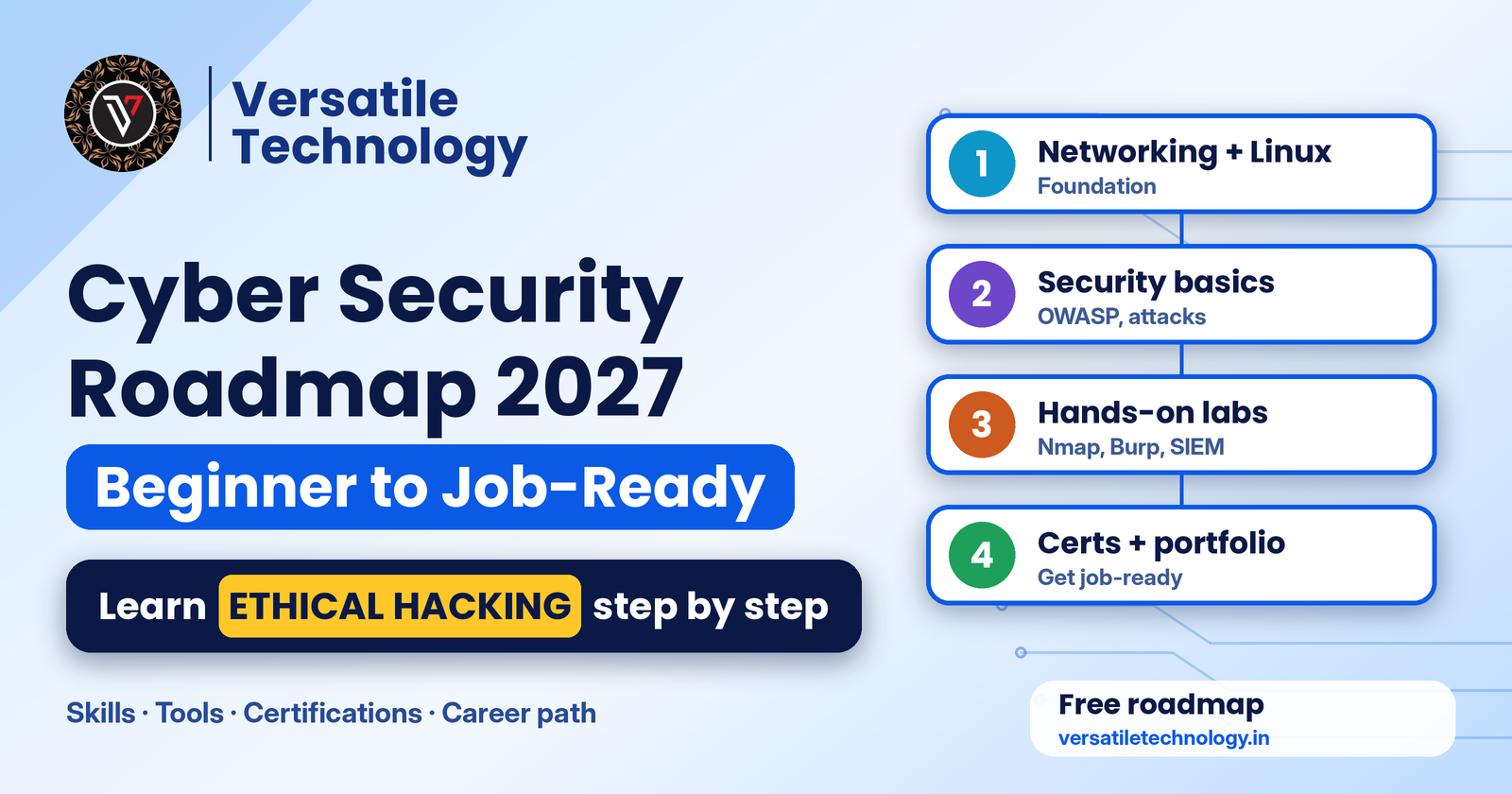
Cyber Security Roadmap 2027: A Beginner's Step-by-Step Guide
The most reliable way to start a cyber security career is to learn in layers: IT and networking basics, Linux, core security concepts, hands-on labs, then one specialisation (such as SOC analyst or ethical hacking), backed by a beginner certification and a portfolio of documented projects. With 10 to 15 hours of focused study a week, most beginners need roughly 6 to 12 months to reach entry-level readiness.
That is the short answer. The rest of this guide explains each stage, the tools to practise, the certifications that matter, and the career paths you can choose from, so you can follow a clear plan instead of jumping between random tutorials.
What Is Cyber Security?
Cyber security is the practice of protecting computers, networks, applications and data from attacks, theft and damage. It includes defending systems (blue team), testing them the way an attacker would (red team and ethical hacking), and managing risk and compliance.
Every business with a website, an app or customer data needs these skills, which is why the field has so many different roles. It is not only for hackers in movies. Most cyber security work is careful, methodical problem solving.
The Roadmap at a Glance
| Stage | What you learn | What you do |
|---|---|---|
| 1. IT and networking basics | IP, DNS, HTTP, ports, how the internet works | Trace a web request from browser to server |
| 2. Linux and command line | Files, permissions, processes, basic scripting | Use Linux daily in a virtual machine |
| 3. Security fundamentals | CIA triad, common attacks, authentication, encryption | Study real attack types and how to stop them |
| 4. Web security | OWASP Top 10, input validation, session handling | Practise on intentionally vulnerable apps |
| 5. Hands-on labs and tools | Nmap, Wireshark, Burp Suite, log analysis, SIEM basics | Complete guided labs and write short reports |
| 6. Specialise | SOC, ethical hacking, cloud security or GRC | Pick one path and go deeper |
| 7. Certify and build a portfolio | Beginner certification, documented projects | Publish write-ups and apply for roles |
Want to learn Cyber Security practically?
Learn through hands-on labs, guided practice, practical projects and career guidance.
Step-by-Step: The 7 Stages
Stage 1: Learn Networking and IT Basics
What should I learn first in cyber security? Start with networking, because almost every attack travels over a network. Learn how IP addresses, DNS, HTTP and HTTPS, ports and firewalls work, and what happens between typing a URL and seeing a page.
Many roadmaps stress that cyber security is rarely a true "day one" career, so a solid IT foundation makes everything later easier.
Stage 2: Get Comfortable with Linux
Most security tools run on Linux. Install a Linux distribution in a virtual machine and use the command line every day. Learn file permissions, users and groups, processes, package management and simple shell scripting. A little Python helps you automate repetitive tasks later.
Stage 3: Understand Core Security Concepts
Learn the CIA triad (confidentiality, integrity, availability), authentication and authorisation, hashing and encryption, malware types, phishing and social engineering, and the basics of risk. These ideas appear in every certification and every job interview.
Stage 4: Learn Web Application Security
Web apps are one of the most common targets. Learn the OWASP Top 10, including injection, broken access control, security misconfiguration and weak authentication. Understanding how applications are built also helps, so a basic knowledge of HTML, JavaScript and back-end code goes a long way.
Our guide on the PHP2Shell vulnerability shows how a real-world flaw works.
Stage 5: Practise in Hands-On Labs
Reading is not enough. Practise in legal, safe environments such as vulnerable practice apps and guided lab platforms (TryHackMe, Hack The Box and LetsDefend are commonly used). Learn tools such as:
- Nmap for network scanning
- Wireshark for packet analysis
- Burp Suite for web application testing
- A SIEM tool for log analysis and alert investigation
Important: Only test systems you own or have written permission to test. Unauthorised testing is illegal.
Stage 6: Choose a Specialisation
Pick one direction after you have the basics (see the next section). Going deep in one area gets you hired faster than knowing a little about everything.
Stage 7: Certify, Document and Apply
Earn one beginner certification, publish short write-ups of labs you completed, and keep a portfolio of what you can do. Employers want proof of skill, and documented lab work shows it.
See how one of our students turned practice into public recognition in Akash's Researcher Hall of Fame story.
Choose Your Cyber Security Career Path
| Path | What you do | Good starting skills |
|---|---|---|
| SOC analyst (blue team) | Monitor alerts, investigate incidents | Networking, logs, SIEM tools |
| Ethical hacker / penetration tester | Find weaknesses before attackers do | Web security, Linux, scripting |
| Bug bounty researcher | Report vulnerabilities through disclosure programs | OWASP, careful reporting |
| Cloud security | Secure cloud platforms and configurations | Cloud basics, networking |
| GRC (governance, risk, compliance) | Policies, audits and risk management | Documentation, standards |
Many sources describe the SOC analyst role as the most widely available entry point, because it builds transferable skills in monitoring, log analysis and incident investigation. If you enjoy breaking things safely, the ethical hacking and bug bounty path may suit you better. Note that bug bounty rewards depend on the program and the severity of what you find, and are never guaranteed.
Certifications That Matter in 2027
Certifications do not replace skills, but they help employers verify them.
| Level | Examples | Best for |
|---|---|---|
| Beginner | CompTIA Security+, ISC2 Certified in Cybersecurity (CC), Google Cybersecurity Certificate | Your first security role |
| Intermediate | CompTIA CySA+, PenTest+, CEH | SOC analysts and penetration testers |
| Advanced | CISSP, OSCP | Senior engineers and advanced testers |
CompTIA Security+ is widely named as the standard first certification, and ISC2 CC is a lower-cost alternative that is free to attempt. CEH is useful for ethical hacking awareness, although some practitioners value hands-on proof of skill more. Certification costs and exam versions change, so always check the official website before you book.
Not sure which Cyber Security path to choose?
Book a free demo session to understand your starting level, course path and practical training approach.
AI and Cyber Security: What Beginners Should Know
AI is changing both sides of the field. Attackers use it for more convincing phishing, and defenders use it for faster detection. A new generation of AI security training has also appeared, for example CompTIA launched its SecAI+ certification in 2026, but it is aimed at people who already have security experience.
For a beginner, the practical advice is simple: master the fundamentals first, learn how AI tools are used (and misused) in security, and always verify what an AI tool tells you before you act on it.
How Long Does It Take to Learn Cyber Security?
How long does it take to learn cyber security from scratch? Roadmaps for beginners commonly plan 6 to 12 months of focused study at 10 to 15 hours a week to reach entry-level employability. A rough schedule:
| Timeline | Focus |
|---|---|
| Months 1 to 2 | Networking, Linux and IT basics |
| Months 3 to 4 | Security fundamentals and web security |
| Months 5 to 6 | Hands-on labs, tools and one certification |
| Months 7 onward | Specialise, build a portfolio and apply for roles |
Your speed depends on your starting point and how much you practise. Hands-on lab time matters more than hours spent watching videos.
Learn Cyber Security in Chhatrapati Sambhajinagar (Aurangabad)
Looking for a cyber security course in Aurangabad, a cyber security course in Sambhaji Nagar, or the best cyber security courses for beginners near you? At Versatile Technology you learn in person, in small batches of a maximum of 3 students, with hands-on labs, live projects and placement support.
Explore our Cyber Security course or our page for the cyber security course in Chhatrapati Sambhajinagar. You can also see real-world security testing in action on our Versatile Bug Bounty platform.
Not sure where to begin? Book a free demo session and our trainers will check your level, explain the syllabus and help you pick the right path.
Quick Checklist: Are You Ready for the Next Stage?
- Can I explain what happens when I open a website?
- Can I move around Linux without a mouse?
- Can I name and explain five items from the OWASP Top 10?
- Have I completed guided labs and written down my findings?
- Do I know which specialisation I am aiming for?
- Do I have one project or write-up I can show an employer?
Build skills employers can actually evaluate.
Practise in labs, build projects, document your work and prepare for entry-level Cyber Security opportunities.
Frequently Asked Questions
What is the cyber security roadmap for beginners?
It is a step-by-step learning order: IT and networking basics, Linux, security fundamentals, web security, hands-on labs, one specialisation, and a beginner certification with a portfolio.
Can I learn cyber security without coding?
You can start many paths, such as SOC analysis and GRC, with little coding. Basic scripting in Python or Bash becomes important for ethical hacking and automation, so it is worth learning over time.
Do I need a degree to start a cyber security career?
A degree is not the only route. Many professionals enter through certifications, hands-on training and a portfolio of documented projects, though some employers still prefer a degree.
Which certification should I take first?
CompTIA Security+ is the most commonly recommended first certification. ISC2 CC is a lower-cost option. Check the current exam details on the official websites.
Is cyber security a good career in India?
Demand for security skills is growing as more businesses move online, but roles vary by city and company. Check current job listings in your area before you decide, and focus on hands-on skills.
What is the difference between ethical hacking and cyber security?
Cyber security is the whole field of protecting systems. Ethical hacking is one part of it, where authorised testers look for weaknesses the way an attacker would, so they can be fixed.
Can I earn from bug bounties as a beginner?
Some people do, but rewards depend on the program and the severity of what you find, and many beginners start with recognition only. Treat it as a skill-building path, not guaranteed income.
How long does it take to become a SOC analyst?
Beginners commonly plan about 6 to 12 months of focused study and lab practice, then apply for junior roles, depending on the time they can give and their starting point.
Is a cyber security course worth it?
A good course gives structure, labs and feedback, which many self-learners lack. Check the syllabus, lab time, batch size and placement support before you enrol.
Where can I learn cyber security in Aurangabad?
Versatile Technology offers in-person cyber security training in Chhatrapati Sambhajinagar (Aurangabad) with small batches and hands-on labs. Book a free demo to see how classes work.
Final Thoughts
Cyber security rewards patience and practice. Build your base in networking and Linux, learn how real attacks work, practise in safe labs, and document what you do. Pick one specialisation, earn one beginner certification, and keep building proof of your skills. Do that consistently and you will have a portfolio that speaks for you.
Certification names, exam versions and prices change often, so check the official websites before you plan. Only test systems you own or have written permission to test.
Ready to Start Your Cyber Security Journey?
- Explore our Cyber Security course
- Cyber security course in Chhatrapati Sambhajinagar
- Read a student's hall of fame story
- Book a free demo session
Visit us
- Gulmandi: 4-8-7 Raj-Ratan Building, Diwan Deodi, Chhatrapati Sambhajinagar 431001
- Chilkalthana (Cidco): Office No. 105, Golden City Center, Chhatrapati Sambhajinagar 431001
- New Usmanpura: 2nd Floor, above Cone-N-Cakes, Mansarovar Arcade, Sant Eknath Rang Mandir Road, New Usmanpura, Chhatrapati Sambhajinagar (Aurangabad), Maharashtra 431005
Call: 9370548454 / 8080503739
Email: sales@versatiletechnology.in